Tokens
A token is resolved when the run happens, not when you write the rule. They work in the issue summary, the description, the due date and in every subtask.
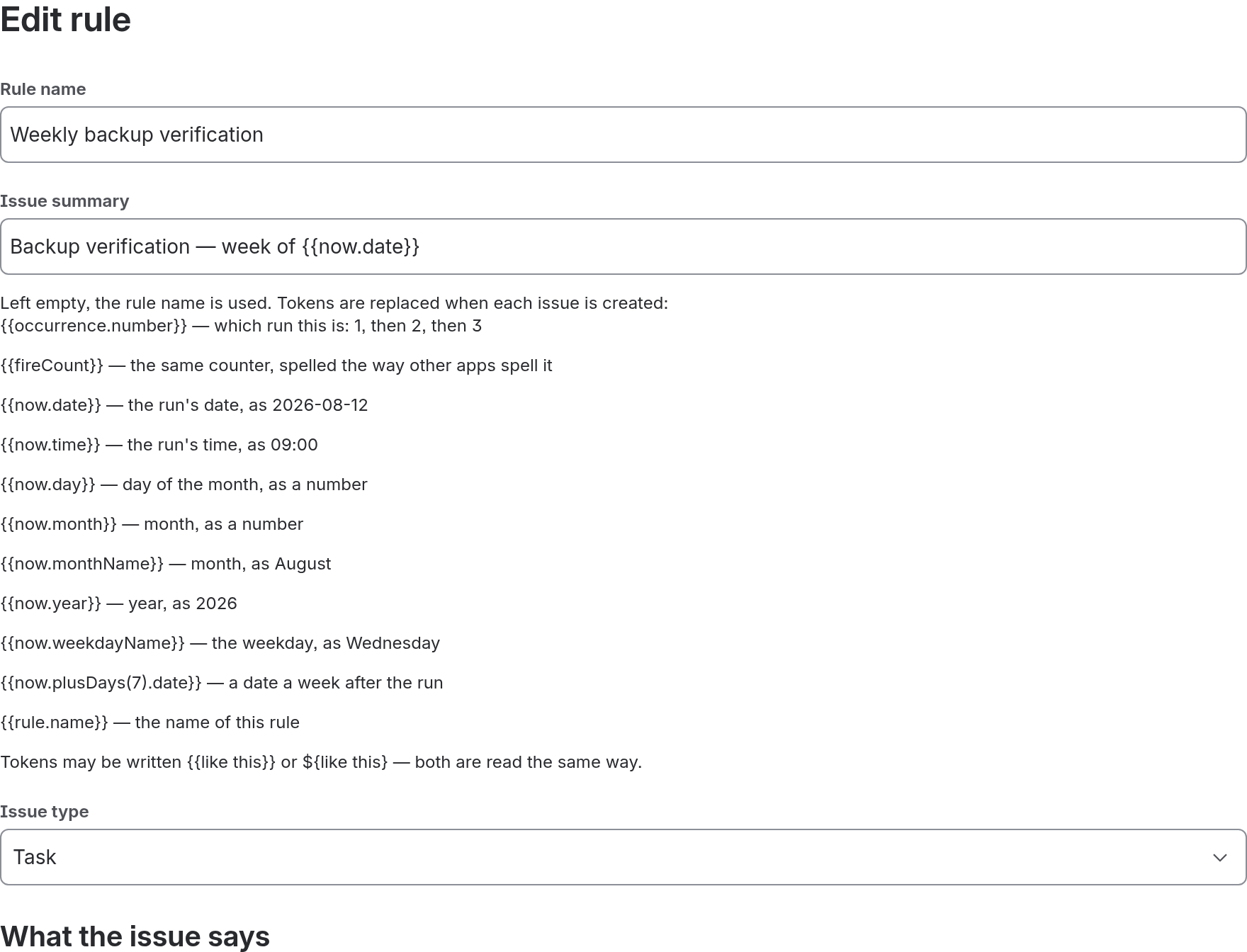
The same list is printed inside the rule editor, under the summary field. It is there rather than behind a help link because a feature nobody can find is the same as one that does not exist — this page is the copy you can bookmark, not the only copy.
The reference
| Token | What it becomes |
|---|---|
{{occurrence.number}} | which run this is: 1, then 2, then 3 |
{{fireCount}} | the same counter, spelled the way other apps spell it |
{{now.date}} | the run's date, as 2026-08-12 |
{{now.time}} | the run's time, as 09:00 |
{{now.day}} | day of the month, as a number |
{{now.month}} | month, as a number |
{{now.monthName}} | month, as August |
{{now.year}} | year, as 2026 |
{{now.weekdayName}} | the weekday, as Wednesday |
{{now.plusDays(7).date}} | a date a week after the run |
{{rule.name}} | the name of this rule |
Both spellings work
Tokens may be written {{like this}} or ${like this} — both are read the same way.
That is not tidiness. If you are moving from another scheduling app, the strings you already
have keep working: {{fireCount}} is one app's spelling of the occurrence counter,
{{template.counter}} is another's, and {{occurrence.number}} is this
one's. All three mean the same number. Finding out which of the three this app happens to prefer
is not a task worth giving anyone.
Date arithmetic
now can be moved before a property is read from it:
| Call | Moves the |
|---|---|
plusMinutes(n) / minusMinutes(n) | instant — "an hour later" |
plusHours(n) / minusHours(n) | |
plusDays(n) / minusDays(n) | calendar — "tomorrow, same time" |
plusWeeks(n) / minusWeeks(n) | |
plusMonths(n) / minusMonths(n) |
The split matters on the two mornings a year when the clocks change, and only then: an hour later is not the same as tomorrow at the same time.
After a move, read a property off it: {{now.plusWeeks(2).date}},
{{now.minusDays(1).weekdayName}}. Beyond the ones in the table above,
hour, minute and weekday (as a number, Monday = 1) are
also readable.
An argument may be at most 10,000 in either direction.
What happens to a token that is wrong
The editor refuses to save it. An unknown token is reported when you press Save,
naming the token, rather than being discovered months later in an issue title reading
Board review {{occurence.number}}. A half-written token such as
{{occurrence}} is refused for the same reason: answering it with something
plausible would hide the typo.
A due-date expression additionally has to end in .date — Jira's due date is a
date, and an expression resolving to a date and a time is rejected at save rather than
by Jira at run time.
Two worked examples
A quarterly review that can be told apart in a backlog
Summary:   Board review {{occurrence.number}} — {{now.monthName}} {{now.year}}
Repeats:   Every month, on a date · Every 3 · day 1
Due date:  1 week after
The first three issues are titled Board review 1 — January 2026, Board review 2 — April 2026, Board review 3 — July 2026.
A due date three days out, on a project that does not work weekends
Due date:  An expression I write myself
           {{now.plusDays(3).date}}
Counted from each run, not from today. And if the rule is set to move off a non-working day, the run moves first and the due date is then counted from where it landed — so the three days are three days from the issue actually appearing.